
IUNGO BDI / Technical Insights

IUNGO BDI.
Flow, activation, and testing.

To integrate IUNGO BDI with your ERP, explore the exchange flow, POP, ACK, and PUSH operations, activation phases, and technical documents. The connection between BDI and the supplier's ERP is the responsibility of the supplier.

What is IUNGO BDI

Document exchange.
The integration flow.

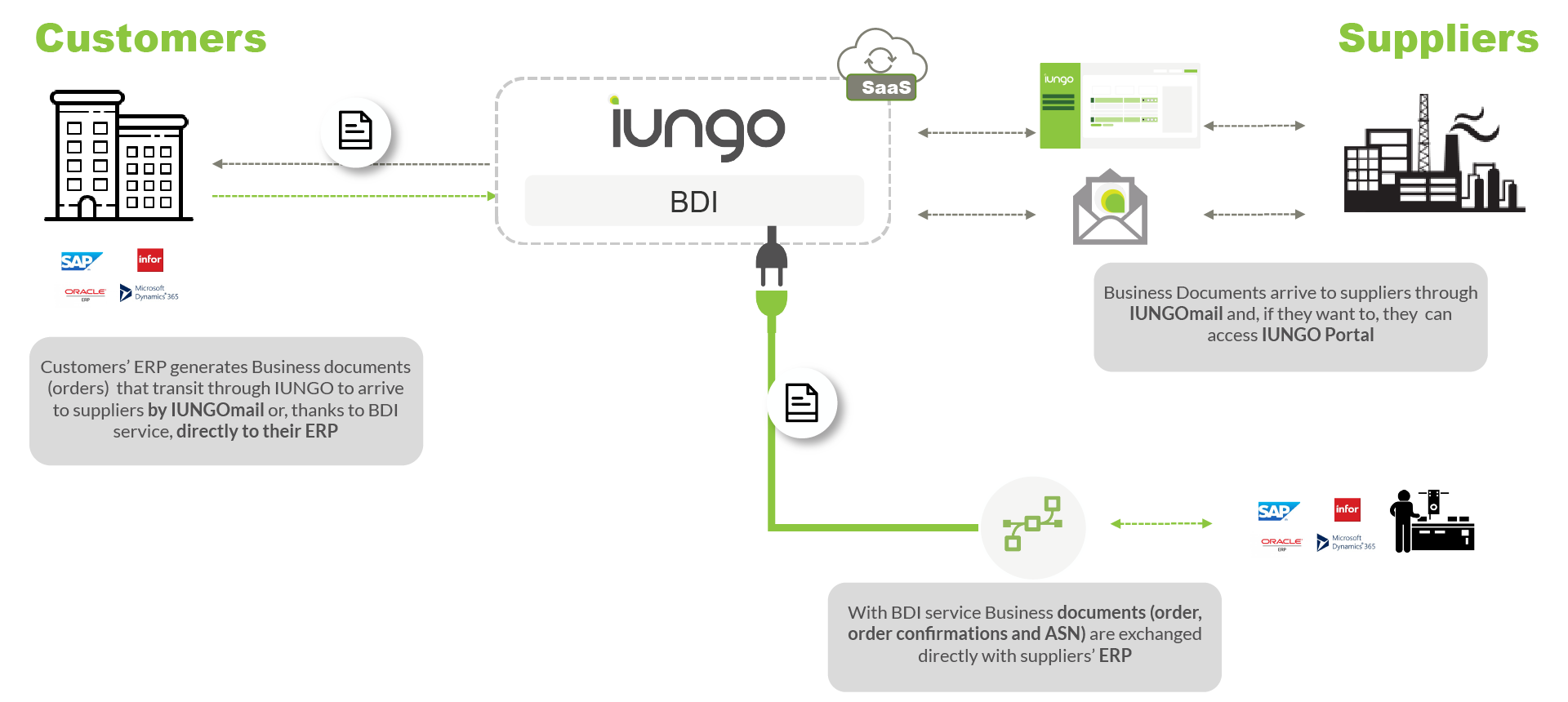
IUNGO Business Data Integration is the solution that allows to automate the exchange of business documents between customers and the suppliers integrated on the IUNGO platform.

Back to features and benefits
IUNGO BDI Integration Flow diagram
How does it work? Take a look at the flow. Click the diagram to open it in full resolution.
How does it work? Here you find the process!

POP, ACK, and PUSH operations.

Connection methods and parameters specified for each operational endpoint.

POST

POP

Download a document from IUNGO BDI.

This allows the Partner to download all documents that were forwarded to him, one at a time.

Connection Methods

Protocol
https
URL-host
icn.iungoapps.com
Request type
POST
Service
v2.0/webapi/pop/orders v2.0/webapi/pop/ordrsp v2.0/webapi/pop/desadv
Accept
application/xml
Authorization
Bearer APIKEY
POST

ACK

Confirm the download operation.

This allows the Partner to confirm the correct download of a document from the IUNGO BDI platform.

Connection Methods

Protocol
https
URL-host
icn.iungoapps.com
Request type
POST
Service
v2.0/webapi/ack
X-Receipt-Handle
receiptHandle
Authorization
Bearer APIKEY

{receiptHandle} is automatically generated for each document and is used to confirm the document download

POST

PUSH

Upload a document to IUNGO BDI.

This allows a Partner to connect and send a document to IUNGO BDI.

Connection Methods

Protocol
https
URL-host
icn.iungoapps.com
Request type
POST
Service
v2.0/webapi/push/orders v2.0/webapi/push/ordrsp v2.0/webapi/push/desadv
Content-type
application/xml
Authorization
Bearer APIKEY
Service Activation

Prepare integration and testing phases.

Activation must be carried out independently by the user.

01

Follow the RUNBOOK

The RUNBOOK describes all the use case tests required for full integration.

02

Use IUNGObptest

A "TEST Business Partner" named "IUNGObptest" is available on the platform to test and validate the BDI service integration using certified use cases. This is a fictitious company designed for testing purposes.

Testing Phases in Detail

Three sub-groups to validate the integration.

01

Download and acquisition

Test document download and upload of data acquisition confirmation.

02

Order lines and split

Test updating order lines across all order types, verifying split management where applicable.

03

DESADV dispatch

Test sending of DESADV (Advance Shipping Notice).

Shared Technical Documentation

Specifications, schemas, and example files.

Direct links to integration specifications, schema definitions, and testing files.

PDF

[BDI]_Platform_Integration_Specifications

Document detailing technical connection to the platform.

Open document
PDF

[BDI]_Standard_XML_record

XML specification document used to communicate with the platform.

Open document
XSD

[BDI]_SCHEMA ORDERS_ORDRSP.xsd

Schema detailing the technical structure of ORDERS and ORDRSP.

Open schema
XSD

[BDI]_IUNGO_SCHEMA DESADV.xsd

Schema detailing the technical structure of DESADV.

Open schema
XLSX

[BDI]_RUNBOOK

Template detailing test execution and validation steps.

Open file
ZIP

EXAMPLE FILES

Sample XML payloads for technical reference and mapping.

Open archive
Technical FAQ

Responsibilities, data, and integration.

Does IUNGO BDI guarantee that my business partner sends me all documents: for example all confirmations, all Desadv, and/or all orders?

NO, it is up to the sender to decide which and how many documents to send (or not to send) to the recipient. Therefore, it is the supplier's responsibility to decide whether to send all confirmations and/or Desadv to the customer, just as it is the customer's responsibility to decide whether to send all orders to the supplier and update them after each change.

Can I modify the content of documents sent through IUNGO BDI? For example, adding a custom field only for a specific recipient?

YES, the IUNGO BDI service only verifies compliance with the format for each document type and the presence of "mandatory data" (as indicated in technical specifications). The business content of exchanged data falls entirely within the autonomy and responsibility of the sender.

Does IUNGO BDI validate the business meaning of exchanged data?

BDI ensures document delivery and payload syntax validation, but not semantic business meaning. The semantic meaning of data contained in exchanged documents and custom business rules must be agreed between partners outside of the platform.

Does IUNGO BDI guarantee that all data important to me is present in received documents?

NO, IUNGO BDI guarantees the presence of "mandatory" data required by the communication standard. If a document does not contain mandatory information, IUNGO BDI rejects it, notifying the sender. It is the sender's responsibility to populate the "optional" fields needed by the recipient.

Who builds the connection between IUNGO BDI and the supplier's ERP?

IUNGO does not build the connection between BDI and the supplier's ERP. Connecting to BDI is the responsibility of the supplier.