

 English
 Italiano
Regulatory compliance
Documentation workflows fully aligned with international customs legislation, shielding your company from penalties and tariff benefits revocation.
From requesting origin declarations from suppliers to subsequent verification, validation, and automated export to your ERP.
| Item Code | Declared Origin | Status |
|---|---|---|
| ART-MECC-894 | Italy (EU) | Filled |
| CAB-ELETTR-102 | Under customs review | Sent |
| VALV-PNEUM-340 | Declaration pending | To be certified |
Compliant customs declarations · illustrative data
Goods origin declarations are crucial documents in international trade: they certify where a product was manufactured and determine eligibility for reduced tariffs, trade preferences, and compliance with bilateral agreements between countries. A mistake or gap in this documentation can lead to severe customs penalties, shipping delays, border disputes, and unexpected costs that directly disrupt your supply chain.
Despite their strategic importance, many organizations still collect and manage these declarations manually using spreadsheets, scattered emails, and non-uniform paper certificates. The outcome? Sluggish workflows, poor traceability, and an inability to ensure that all declarations are up to date and fully aligned with evolving customs regulations.
This is where digitalization becomes essential: centralizing and automating the management of goods origin declarations empowers Purchasing, Logistics, and Trade Compliance teams to mitigate risks, simplify audits, and maintain full, real-time visibility across the entire supply chain. A digital platform tracks supplier accountability, collects standardized declarations, monitors expirations, and integrates smoothly with vendor onboarding and qualification workflows.
To eliminate penalties and customs hold-ups caused by inaccurate or missing origin proofs, declaration requests must be automated and synchronized directly with your ERP. With the IUNGO Goods Origin Declarations Module, the list of items is extracted from the ERP or issued alongside purchase orders and sent to suppliers via interactive IUNGOmail. Suppliers declare the country of origin, preferential status, customs codes, and dual-use applicability directly from their email inbox, attaching signed declarations. Once validated by the buyer, the data automatically updates your ERP item master in one click, enabling your customs and shipping teams to operate with total legal certainty.
How vendor requests, preferential origin calculations, and audit readiness evolve when moving from spreadsheets to automated digital workflows.
| Customs Activity | Traditional Method (Static Emails / Excel Files / Paper) | IUNGO Platform (Automated Goods Origin Management) |
|---|---|---|
| Request Generation |
Complex & Manual Manual extraction from ERP generating disjointed, non-standardized Excel files. |
Via ERP or Purchase Orders Automated extraction from your ERP or simultaneous issuance with purchase orders in IUNGO. |
| Supplier Collection Campaigns |
Endless Chasing Months spent following up via phone and email for forms that often return incomplete. |
100% via IUNGOmail Pre-populated tables dispatched via email with fast compilation options via Excel upload. |
| Customs Scope & Compliance |
Partial Data High risk of missing details on customs classification, dual-use items, or cumulation. |
Full Compliance Fields Structured entries for Country of Origin, preferential status, Dual Use, customs code, and cumulation. |
| ERP Item Master Updates |
Manual Data Entry Typing origin codes line-by-line back into the ERP, introducing severe clerical error risks. |
1-Click ERP Export Automatic export of validated origin data and updated certificates directly into ERP master records. |
| Customs Audit Traceability |
High Risk Scattered evidence and difficulty locating original signed proofs during retrospective customs audits. |
Complete Audit Trail Centralized digital repository with signed PDF declarations instantly retrievable on demand. |
Managing the customs origin of goods requires absolute precision and rigorous documentation. The IUNGO module provides dedicated tools engineered to streamline your trade compliance operations:
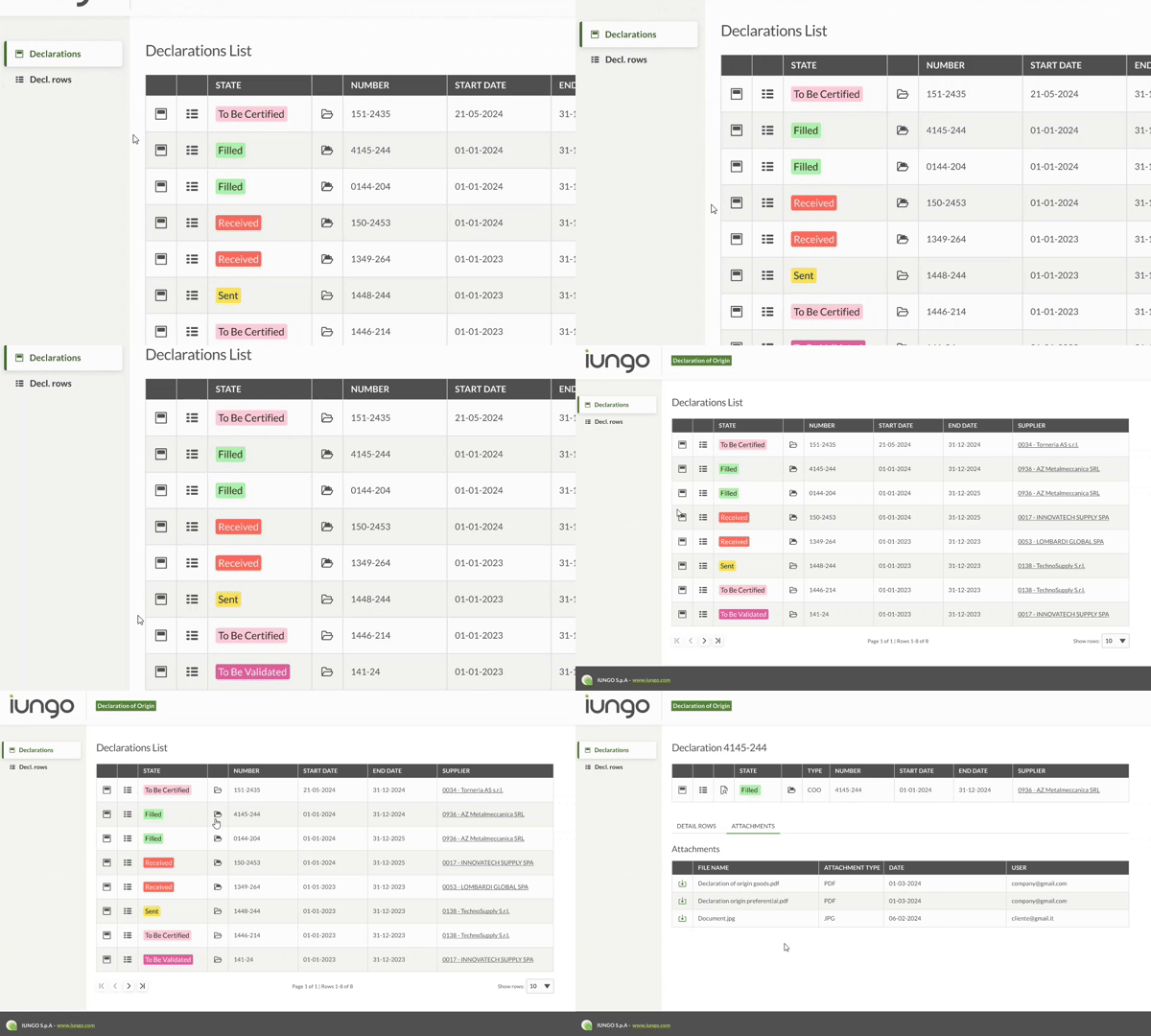
Documentation workflows fully aligned with international customs legislation, shielding your company from penalties and tariff benefits revocation.
Effortless archiving and fast retrieval of origin declarations. End-to-end visibility and status tracking within a single, updated dashboard.
Automated reminders and renewal workflows eliminate hours of tedious, low-value administrative chasing for purchasing and shipping staff.
IUNGO guides your organization and your suppliers step-by-step through every stage necessary to secure complete customs compliance:
Use long-term declarations for continuous coverage over a set period, or short-term declarations for single shipments or varying supply origins.
Allows suppliers to declare whether cumulation agreements apply and accurately track declarations for items subject to dual-use controls.
Buyers inspect attached declarations prior to validation, with the ability to request targeted corrections with specific feedback comments.
No complex portals to access, no usernames or passwords to remember: the list of item codes arrives in an interactive email. The supplier inputs origin countries, verifies preferential statuses, generates compliant forms, signs, and uploads attachments in minutes.
"By automating the management of goods origin requests with IUNGO, we saved 20% of the time of a dedicated resource."
"Calligaris sells worldwide and exports daily; having punctual information on goods origin helps us save significantly. With IUNGO, time savings and data accuracy are guaranteed."
Preferential origin allows for the application of reduced or zero customs duties under international free trade agreements, while non-preferential origin (Made In) serves statistical, trade policy, and customs compliance purposes. Managing both correctly directly impacts costs, legal penalties, and shipment continuity.
Digital management allows organizations to collect, update, and verify origin declarations in a structured format linked directly to purchased parts. This eliminates manual errors, prevents supply delays, and provides complete documentary support for customs audits.
The buyer triggers the request within the ERP system, prompting IUNGO to extract required items, or can issue it directly from the Purchase Orders Module alongside the purchase order.
Yes. With IUNGO you manage both Long-Term Supplier Declarations (LTSD) and short-term declarations—covering both preferential and non-preferential origin—through legally compliant IUNGOmail forms.
No. The interface is intuitive and operates entirely through IUNGOmail, accessible directly within the supplier's standard email client without any specialized training or software installation.
Fill out the form to download the comprehensive product sheet detailing all capabilities of the IUNGO Goods Origin Declarations Module.